So, I just watched Meiyazhagan. What, with all the Diwali fanfare it made sense to watch something cozy and contemporary. It’s on netflix, and it’s been all the rage for the past week. So me and my family walked in completely blind. And it was worth it a hundred times over.

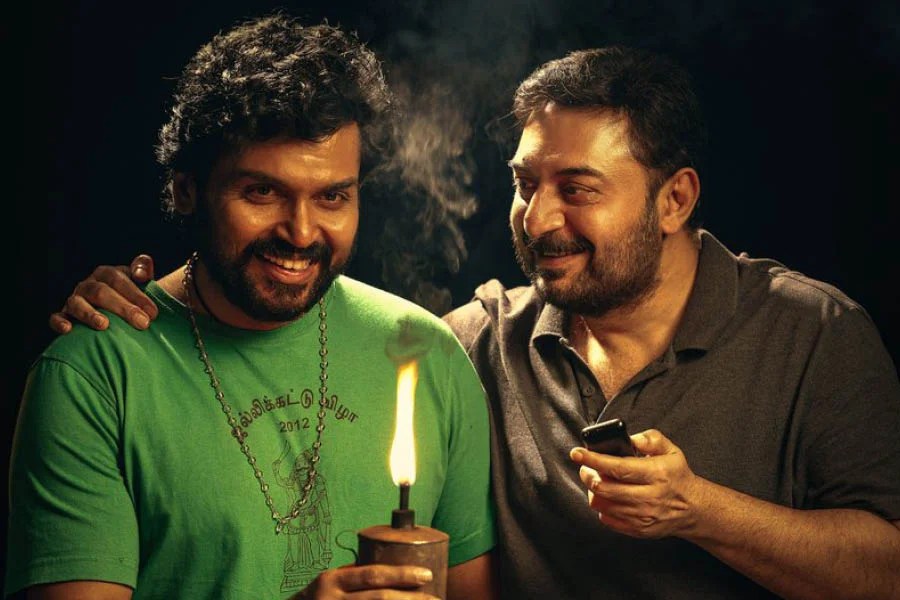
A quick breakdown for the uninitiated: ‘Meiyazhagan’ is the story of Arulmozhi, an urbanized middle-aged man as he revisits his childhood hometown 22 years after migrating to the city. It follows him as he begrudgingly returns for a relative’s wedding and is a little too affectionately welcomed by a young man who claims to be his close childhood friend. Arul himself, has no memory of him. As he shies away from asking for his name and admitting that he has no idea who he is, he spends the whole night with him under the pretence of recognizing him.
To surmise my takeaway from the story, it feels directly out of a Ruskin Bond novel, if Bond lived in rural Tamil Nadu. It was poignant, heart-warming, and revelational. It even moved my cool-as-ice dad who watches every movie with the utmost degree of seriousness. And to be fair, I can’t really blame him. It carries the viewers through a well-timed, meticulously engineered roller-coaster using specific story techniques. These tricks have been used time, and time, and time again. They transcend stuff like originality and novelty. In true Ruskin Bond fashion, they’re seamless, so much so, that you never even realize where the story started and where it ended. But you were carried through with anticipation the whole time. You feel like you just experienced viewer whiplash. I want to give my readers reader whiplash.
Let’s find out how. Pick up any story at home and try this with me. Let’s break down Meiyazhagan

The story followes the 3-act story structure. That explains why it packs such an emotional punch. The first act always consists of an fundamental hook, an inciting incident, and a fear-based reaction to said inciting incident.
HOOK: The opening scene of a story, intended to reveal a character’s core character trait and reveal the root cause of the misbelief which is to be broken by the end of the story.
Reference: Arulmozhi leaves his hometown, cementing his fear of reliving those memories ever again and forming the misbelief that in order to evade heartbreak he must never revisit this chapter of his life again.
INCITING INCIDENT: The first move of the plot, which shoves the character into action. It’s a break from the status quo of our character’s life and pushes them out of their comfort zone.
Reference: Arulmozhi is invited to a wedding, where he encounters an obnoxious, clingy young man who claims to recognize him.
REACTION (Self-coined term here, but I promise it counts) : The protagonist’s decision to step into the ring and embark on an adventure (Narrative and emotional).
Reference: Arulmozhi pretends to recognize the man and does everything in his power to get home as fast as he can while trying to get him off his tail.
If the first act builds the base, the second act builds the walls. The second act usually consists of 3 core elements:
FEAR-BASED ACTION: This is where our protagonist’s misguided plans are set in motion, the first few chapters of their adventure. Nothing unexpected in their way so far.
Reference: Arulmozhi’s plans to get home are botched, which leads him to look for a lodging house. He’s mad, but his agenda remains unchanged. He must get home, no matter what it takes.
REVELATION: Our character’s first game-changing discovery, undermining 50% of everything they have believed so far.
Reference: Arulmozhi is forced to stay at the stranger’s house for a night. It’s a warm home, and as the stranger rambles on about their supposed “old times” together, Arulmozhi realizes how much of a main-player he has been in this young man’s life.
REVELATION-BASED AND FEAR-INSPIRED ACTION: The character clumsily adapts to the new rules. His agenda remains unchanged, but the aftershock of the recent revelation has started to reveal tiny cracks on its surface.
Reference: Arulmozhi decides to play along for a little while. Beginning to ease up a little, he embraces the young man’s enormous affection and spends a nostalgically beautiful night with him. All while he pretends to know exactly who he is.
The time has come, for the third act to swoop in and savagely destroy the building we just worked for two hours or 25 chapters to make.
DISASTER: Crisis strikes, botching our characte’r entire plan and demolishing their blueprint. They’re ruined, their agenda is hopeless. It’s all their fault and a result of their poor decisions. It breaks them utterly.
Reference: The stranger questions why Arulmozhi hasn’t once said his name or blessed him as an older brother. In a drunken state, right before dozing off he makes him promise to bless him by name first thing next morning. Panicked, Arulmozhi runs away in the dead of the night. Back home, he’s devastated, guilty, drowning in self-hate.
AHA MOMENT: Our protagonist rises from the ashes, finally seeing the lie hidden underneath all the rubble: the lie that they had been believing. Now, they fear nothing. They’ve seen the light. It took a long time and a shattering disaster, but it’s all worth it now.
Reference: Arulmozhi realizes how selfish and short-sighted he had been, avoiding his people and his family, evading invitations. He sees how cynical this life has made him, and yearns for the extended warmth he recieved at the house of a man who’s first name is still a complete mystery.
FACE-OFF/CLIMAX: Armed with the truth, having vanquished their fear, the protagonist faces the conflict before them. The character makes their ultimate confession, heals the broken relationship, takes that ultimate step, fights that insurmountable battle.
Reference: Arulmozhi’s daughter, seeing her father’s distraught state, forces him to call the stranger. The two of them share a heartfelt conversation on the phone. Wracked with nerves, Arulmozhi confesses. The stranger cries, then laughs, then sits himself down on his veranda. It’s time. He starts telling Arulmozhi a story, an inspired-by-true-events story. A story of a young boy who came to a village as a kid and met an older guy named Arul who spent the summer with him, teaching him incredible things and taking him on incredible adventures. He tells how the older guy had given him a nickname. The nickname was after a vegetable. A nickname, which Arulmozhi recognizes instantly. Immediately, Arulmozhi books a flight back home, and runs up to the stranger’s house, knocking on the door, delightfully calling: “MEIYAZHAGAN, OPEN THE DOOR!”
End scene.
Meiyazhagan checks all the boxes. Every plot point flows into the next one like water. It’s seamless, satisfying, and insanely addictive. It’s everything to warm up your soul, to fill you up with passion, to undo the knots in your heart.
It’s impossibly genius. And trust me, when the reviews say things like:
“Simply beautiful” or “Exceptional” or “I don’t usually review movies but this one is just excellent.”
You know they have probably done something right.
 Story Scientist
Leave a Reply